
Change samping frequency#
Sometimes we require resample survey data at either a heigher or lower sampling frequency. Here we show how to do both.
[2]:
# %load_ext autoreload
# %autoreload 2

import cmocean
import matplotlib.pyplot as plt
import numpy as np
import pandas as pd
import verde as vd

import airbornegeo
[ ]:
data_df = pd.read_csv("data/AGAP_gravity_survey_processed.csv")
data_df = data_df[
    [
        "easting",
        "northing",
        "line",
        "unixtime",
        "distance_along_line",
        "grav_disturbance_filt",
    ]
][::5]  # every 5th point
data_df.head()

survey = airbornegeo.Survey(data_df, line_column="line")
data_df = survey.data
Reduce sampling frequency#
For this we will use block-reduction, where we define spatial windows (1D), or blocks (2D), and for all data within the block, retain only the mean or median values.
[4]:
# extract a single line from the survey
line_df = data_df[data_df.line == 8]
line_df
[4]:
| easting | northing | line | unixtime | distance_along_line | grav_disturbance_filt | |
|---|---|---|---|---|---|---|
| 21815 | 1.064934e+06 | 327364.065720 | 8 | 1.230574e+09 | 202.954030 | 56.97 |
| 21820 | 1.065268e+06 | 327411.697676 | 8 | 1.230574e+09 | 540.476913 | 55.86 |
| 21825 | 1.065601e+06 | 327464.248325 | 8 | 1.230574e+09 | 878.033672 | 54.83 |
| 21830 | 1.065934e+06 | 327524.876461 | 8 | 1.230574e+09 | 1216.298627 | 53.83 |
| 21835 | 1.066267e+06 | 327589.259632 | 8 | 1.230574e+09 | 1555.357945 | 52.86 |
| ... | ... | ... | ... | ... | ... | ... |
| 25255 | 1.321821e+06 | 373028.825792 | 8 | 1.230578e+09 | 261161.216753 | -0.68 |
| 25260 | 1.322151e+06 | 373081.094428 | 8 | 1.230578e+09 | 261495.865268 | -0.63 |
| 25265 | 1.322480e+06 | 373141.185876 | 8 | 1.230578e+09 | 261829.523736 | -0.47 |
| 25270 | 1.322807e+06 | 373203.581372 | 8 | 1.230578e+09 | 262162.742950 | -0.22 |
| 25275 | 1.323135e+06 | 373265.681016 | 8 | 1.230578e+09 | 262496.663302 | 0.07 |
693 rows × 6 columns
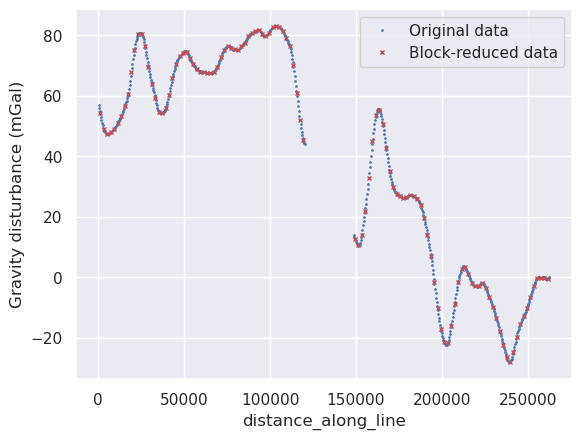
Block-reduce by distance#
By setting reduce_by to ‘distance_along_line’ and spacing to 2000, we can block reduce the data to have 1 point every 2000 meters.
[ ]:
line_survey = airbornegeo.Survey(line_df, line_column="line")
blocked_line = line_survey.block_reduce(
    np.median,
    spacing=2000,
    reduce_by="distance_along_line",
).data
[6]:
ax = line_df.plot.line(
    "distance_along_line",
    "grav_disturbance_filt",
    style="bp",
    ms=1,
    label="Original data",
)
ax = blocked_line.plot.line(
    "distance_along_line",
    "grav_disturbance_filt",
    style="rx",
    ms=3,
    ax=ax,
    label="Block-reduced data",
)
ax.set_ylabel("Gravity disturbance (mGal)")
[6]:
Text(0, 0.5, 'Gravity disturbance (mGal)')
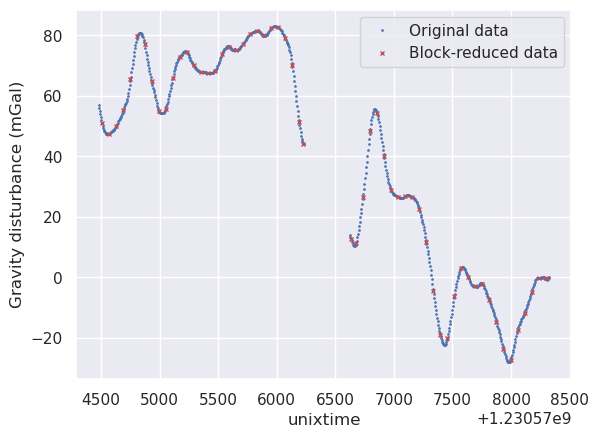
Block-reduce by time#
By setting reduce_by to ‘unixtime’ and spacing to 60, we can block reduce the data to have 1 point every minute along the flight.
[ ]:
line_survey = airbornegeo.Survey(line_df, line_column="line")
blocked_line = line_survey.block_reduce(
    np.median,
    spacing=60,
    reduce_by="unixtime",
).data
[8]:
ax = line_df.plot.line(
    "unixtime", "grav_disturbance_filt", style="bp", ms=1, label="Original data"
)
ax = blocked_line.plot.line(
    "unixtime",
    "grav_disturbance_filt",
    style="rx",
    ms=3,
    ax=ax,
    label="Block-reduced data",
)
ax.set_ylabel("Gravity disturbance (mGal)")
[8]:
Text(0, 0.5, 'Gravity disturbance (mGal)')
Block-reduce all lines in a survey#
By supplying ‘line’ to the groupby_column, the block-reduce occurs only on 1 line at a time. This means for lines that are closer together than the spacing, or where lines cross, the values from other lines within the same block are not included in the block-reduction.
[ ]:
blocked_survey = survey.block_reduce(
    np.median,
    spacing=5000,
    reduce_by="distance_along_line",
)
blocked_survey.data
[ ]:
max_abs = vd.maxabs(survey.data.grav_disturbance_filt, percentile=95)

ax = survey.data.plot.scatter(
    "easting",
    "northing",
    c="grav_disturbance_filt",
    s=0.1,
    cmap=cmocean.cm.balance,
    vmin=-max_abs,
    vmax=max_abs,
    colorbar=False,
    title="Original data",
)
ax.set_aspect("equal")
plt.colorbar(ax.collections[0], ax=ax, shrink=0.6)
plt.show()
[ ]:
ax = blocked_survey.data.plot.scatter(
    "easting",
    "northing",
    c="grav_disturbance_filt",
    s=0.1,
    cmap=cmocean.cm.balance,
    vmin=-max_abs,
    vmax=max_abs,
    colorbar=False,
    title="Block-reduced data",
)
ax.set_aspect("equal")
plt.colorbar(ax.collections[0], ax=ax, shrink=0.6)
plt.show()
Increase or change sampling frequency#
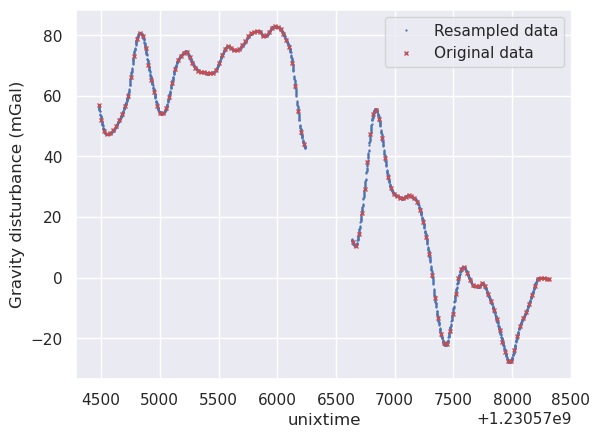
Below we show how to increase the sampling frequency, or resample the data at a specified frequency. This can be done based on any column, but typically you would resample based on a distance along line column, or a time column.
As we can see below, the line data has a value every ~25 seconds.
[12]:
# extract a single line from the survey
line_df = data_df[data_df.line == 8]
# for demonstration, only retain every 5th point
line_df = line_df[::5]

line_df.head()
[12]:
| easting | northing | line | unixtime | distance_along_line | grav_disturbance_filt | |
|---|---|---|---|---|---|---|
| 21815 | 1.064934e+06 | 327364.065720 | 8 | 1.230574e+09 | 202.954030 | 56.97 |
| 21840 | 1.066602e+06 | 327650.536827 | 8 | 1.230575e+09 | 1895.906697 | 51.91 |
| 21865 | 1.068273e+06 | 327963.921140 | 8 | 1.230575e+09 | 3596.305820 | 48.32 |
| 21890 | 1.069939e+06 | 328274.457926 | 8 | 1.230575e+09 | 5291.379412 | 47.31 |
| 21915 | 1.071605e+06 | 328613.652292 | 8 | 1.230575e+09 | 6991.055147 | 47.73 |
[ ]:
line_survey = airbornegeo.Survey(line_df, line_column="line")
resampled_line = line_survey.resample(
    spacing=1,
    resample_by="unixtime",
    maxdist=10,  # only retain data within 10 seconds of original data
).data
[14]:
ax = resampled_line.plot.line(
    "unixtime", "grav_disturbance_filt", style="bp", ms=0.6, label="Resampled data"
)
ax = line_df.plot.line(
    "unixtime", "grav_disturbance_filt", style="rx", ms=3, ax=ax, label="Original data"
)
ax.set_ylabel("Gravity disturbance (mGal)")
[14]:
Text(0, 0.5, 'Gravity disturbance (mGal)')
Resample all lines in a survey#
[ ]:
# for demonstration, only retain every 20th point
survey.data = survey.data[::20]
data_df = survey.data
data_df
[ ]:
resampled_survey = survey.resample(
    spacing=1,
    resample_by="unixtime",
    maxdist=60,  # only retain data within 60 seconds of original data
)
resampled_survey.data
[ ]:
max_abs = vd.maxabs(survey.data.grav_disturbance_filt, percentile=95)

ax = survey.data.plot.scatter(
    "easting",
    "northing",
    c="grav_disturbance_filt",
    s=0.1,
    cmap=cmocean.cm.balance,
    vmin=-max_abs,
    vmax=max_abs,
    colorbar=False,
    title="Original data",
)
ax.set_aspect("equal")
plt.colorbar(ax.collections[0], ax=ax, shrink=0.6)
plt.show()
[ ]:
ax = resampled_survey.data.plot.scatter(
    "easting",
    "northing",
    c="grav_disturbance_filt",
    s=0.1,
    cmap=cmocean.cm.balance,
    vmin=-max_abs,
    vmax=max_abs,
    title="Resampled data",
)
ax.set_aspect("equal")
plt.show()
[ ]: